The Story in the Shield: The RAS Coat of Arms
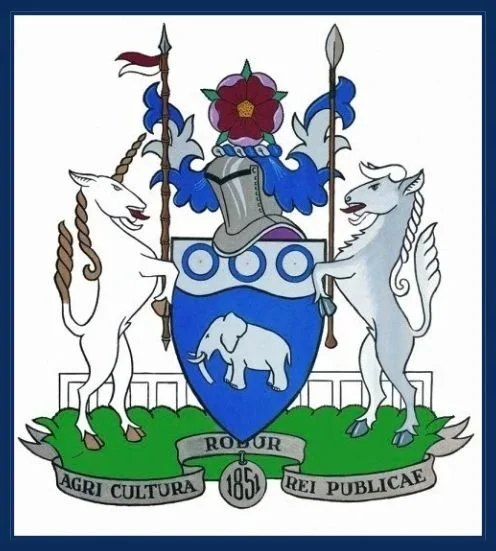
The Royal Agricultural Society’s Coat of Arms has a story to tell.
The Society began life as the Pietermaritzburg Agricultural Society, holding its first Show on 23 December 1851. In 1904 it gained the right to use the title “Royal”, becoming the Royal Agricultural Society of Natal.
More than seven decades later, the Society decided to give its history formal heraldic expression. In 1975, Pietermaritzburg heraldry authority D. E. Clapham, a member of the Heraldry Society of South Africa, was appointed to design and register a Coat of Arms for the RAS. Its registration was formally recorded in the Government Gazette on 28 November 1975, and the new device made its first appearance on the cover of the 1976 Anniversary Show catalogue.
And nothing in the design is accidental.
The unicorn on the left is drawn from the British Coat of Arms. It carries a military lance and pennant, representing the part played by the British Army in the history of Pietermaritzburg and the Royal Show. Opposite it stands a black wildebeest, taken from the former South African and Natal coats of arms. It holds an assegai, intended in the original heraldic description to represent the Zulu nation.
The shield itself is blue and silver. Across its upper section are three blue rings, representing the three different Pietermaritzburg Showgrounds the Society had occupied by the time the arms were designed. Below them, a wavy line represents the Dorp Spruit, which crossed the former Royal Showgrounds. The silver elephant in the lower part of the shield was taken from the Pietermaritzburg Coat of Arms, firmly connecting the Society to the city that was its home for so much of its history.
Above the shield is a red rose. It recalls Pietermaritzburg’s traditional identity as the “City of Flowers”, as well as accounts of roses growing prolifically in the city’s hedgerows in 1851, the year in which the Society was founded. The blue-and-silver mantling completes the crest.
Even the ground beneath the supporters has meaning. The green grass is backed by a white railing modelled on the fence that once surrounded the main arena at the old Pietermaritzburg Showgrounds – a small but wonderfully specific reminder of the Royal Show itself.
Finally comes the motto: Agri Cultura Robur Rei Publicae.
Professor Alexander Petrie, formerly of the Department of Classics at the University of Natal, was consulted over its wording and even insisted upon the separation of Agri Cultura as the better Latin. Its meaning is given as “Agriculture is the strength of the State”.
Historian Bill Guest describes the Coat of Arms as symbolically depicting the different influences that contributed to the Society’s history. That is perhaps the best way to understand it. It is less a logo than a compact historical record: Pietermaritzburg, Natal, agriculture, the Showgrounds, the Society’s British and South African inheritance, and the founding year of 1851, all gathered into one image.
Today, as the Royal Agricultural Society celebrates its 175th anniversary and begins a new chapter at Tweedie, the Coat of Arms remains a fascinating snapshot of the journey that brought it here.
Past, present and future — all contained, in their own way, within the shield.