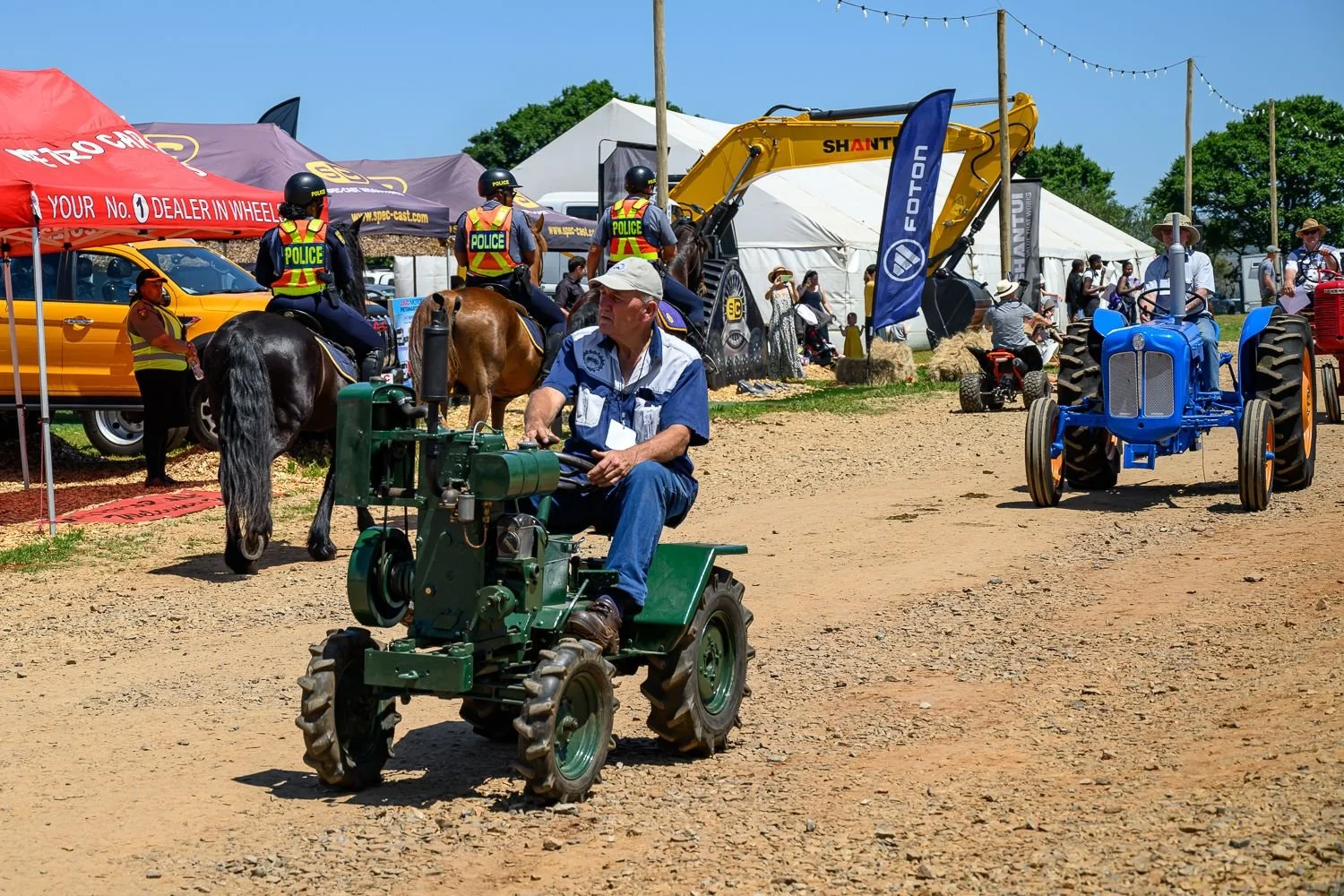
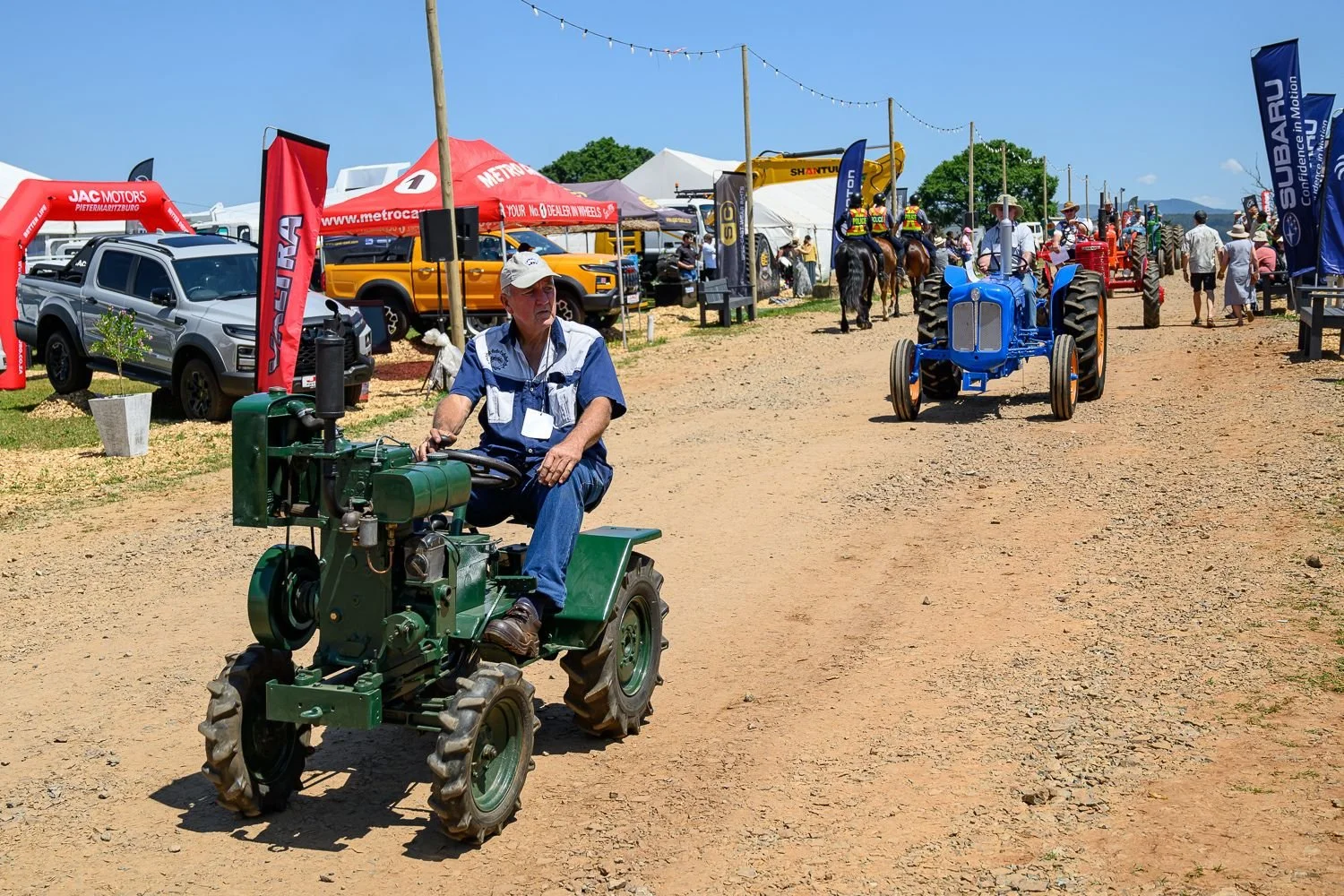
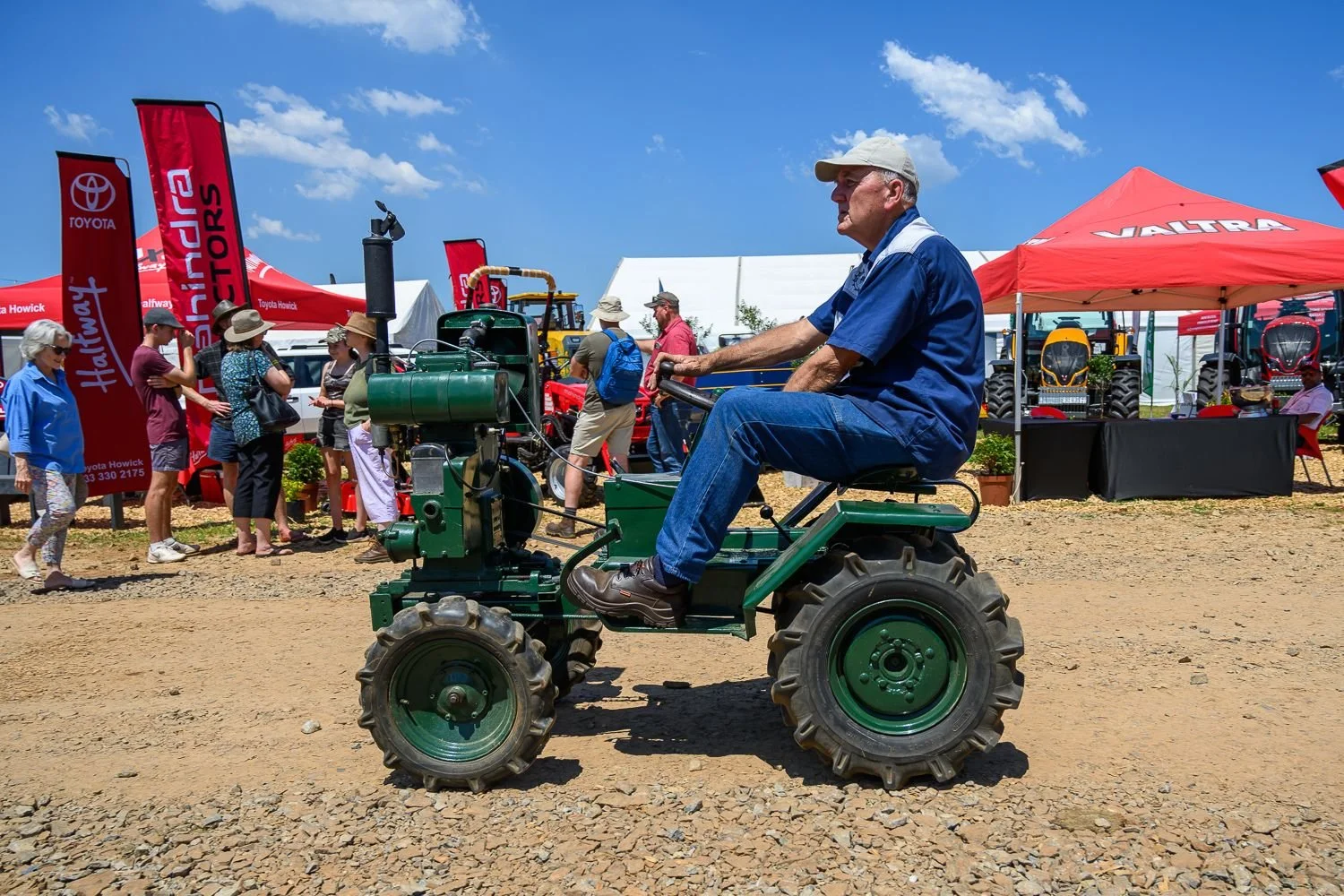
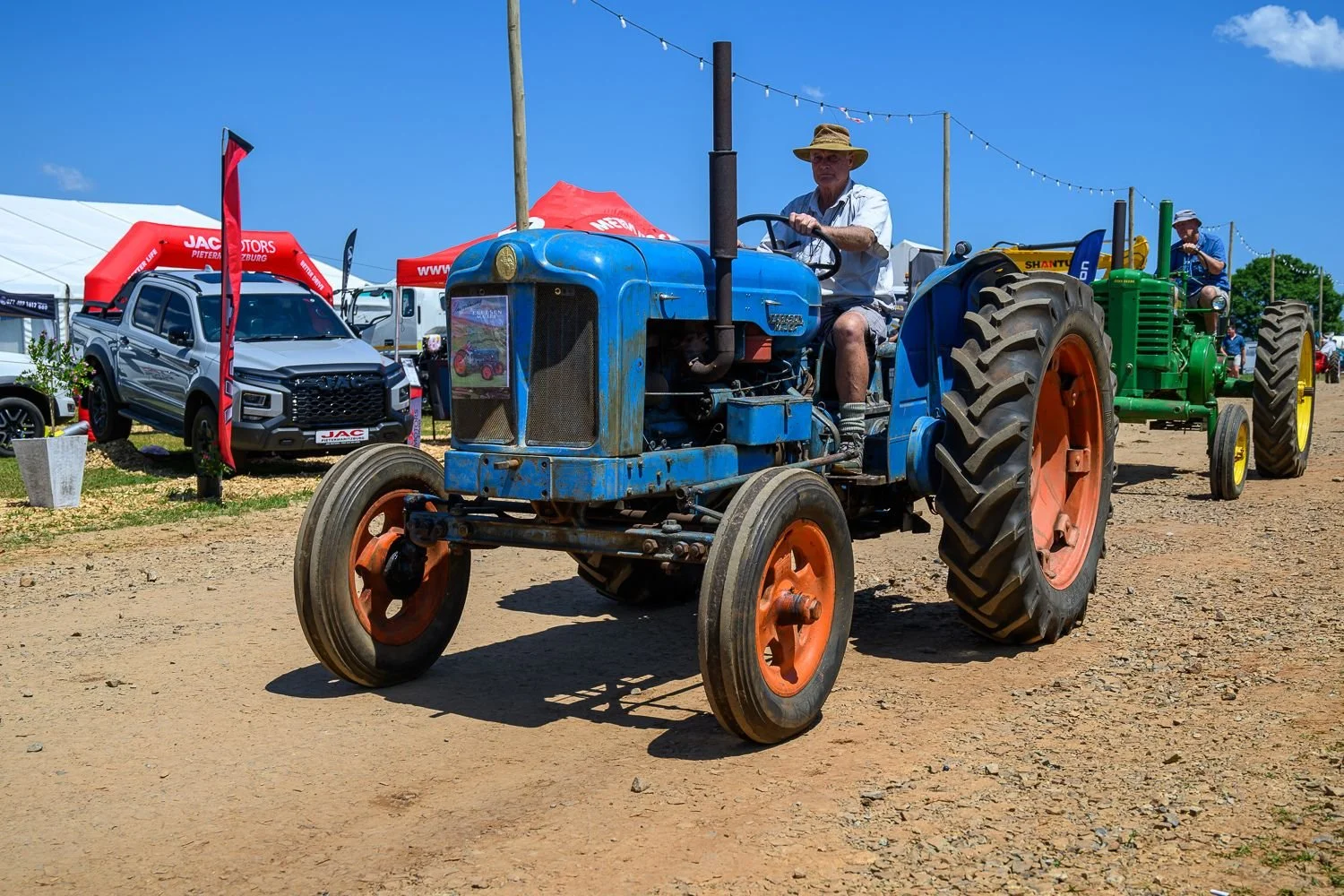
The Natal Vintage Tractor & Machinery Club brought agricultural history to life at the 2026 Royal Show with its award-winning exhibit and vintage tractor parades, giving visitors a fascinating glimpse of the tractors, working stationary engines and historic implements that helped shape South African agriculture.
The sight and sound of vintage tractors making their way through the 2026 Royal Agricultural Showgrounds, with powerful modern machines on display nearby, provided a striking illustration of how far agricultural engineering has progressed.
For the Natal Vintage Tractor & Machinery Club, it was an opportunity to bring agricultural history to life. Its impressive exhibit of vintage tractors, working stationary engines and historic farming implements offered visitors a fascinating glimpse into the machinery that helped shape South African agriculture.
The Club's efforts earned it the Agricon Trophy, presented by the Singh family to the organiser of the Most Attractive Exhibit at the Royal Show.
It was a fitting achievement for a 175th anniversary Royal Show that celebrated Innovation in Agriculture — Past. Present. Future., with the Club's machines providing a tangible connection between the ingenuity of earlier generations and the technology driving modern farming.
For Club chairperson George Goswell and his fellow enthusiasts, however, the exhibition was about much more than nostalgia. It was an opportunity to share their passion for preserving agricultural heritage and the knowledge behind it.
Agricultural history in working order
The Club's contribution extended well beyond its attractive stand. Ten working vintage tractors participated in the tractor parades around the Showgrounds and into the Hollard Arena, giving visitors the opportunity to see and hear machines that had once represented the cutting edge of agricultural technology.
The collection included blue and grey Fordsons, Ferguson tractors, a red McCormick Farmall and examples of vintage John Deere and Case machinery. Their distinctive designs and mechanical simplicity provided an interesting contrast to their modern counterparts exhibited elsewhere at the Show.
The Club also collaborated with other exhibitors, lending a tractor more than a century old to the New Holland stand.
Among the most fascinating exhibits were farming implements that predated widespread tractor use. Some of the ox-drawn equipment dated back to the nineteenth and early twentieth centuries, when farmers walked behind their implements, guiding the depth and direction of the plough while oxen provided the pulling power.
As Goswell explained, somebody would once have spent an entire day walking behind such a machine, controlling both the implement and the animals drawing it.
The working stationary engines offered another glimpse into the practical challenges of rural life before electricity and piped water became commonplace.
Engines like these powered water pumps, generators, sheep-shearing equipment and other essential farm machinery. The Club's exhibit included working examples connected to water pumps and a sheep-shearing machine, while a Baby Hippo mill manufactured by A. Collins & Son provided another interesting demonstration of traditional agricultural equipment.
Rather than simply displaying historical objects, Club members operated the machinery, demonstrating the mechanical ingenuity that transformed everyday farming tasks.
A preservation movement with Pietermaritzburg roots
The Club's history began on 22 April 1988, when six friends gathered in Pietermaritzburg with a shared interest in preserving vintage tractors.
Nic March, Peter Hull, Trevor Lewis, Frans Buys, Bob Wilson and Stewart Campbell established the Vintage Tractor Club of South Africa, laying the foundations for a preservation movement that would spread across the country.
As regional groups developed, the Natal Vintage Tractor Club was formally established on 8 February 1992, with approximately 40 members drawn from the original national organisation.
Its interests soon expanded beyond tractors to include stationary engines and a growing variety of historic agricultural implements. These developments prompted name changes in 1997 and 1999, when it adopted its present name, the Natal Vintage Tractor & Machinery Club.
Today, the Club has 83 members in KwaZulu-Natal, and forms part of a national network of ten clubs with approximately 600 members dedicated to preserving agricultural heritage.
Its home is the historic Baynesfield Estate, near Richmond, where an extensive collection of tractors, engines, steam-powered machinery and agricultural implements is housed in a growing museum and workshop complex.
Saving the machines that helped build agriculture
Much of the equipment in the Club's care has been recovered from farms and deceased estates, often when families are no longer able to maintain or store the machinery.
Rather than allowing these machines to disappear into scrapyards, members undertake the painstaking work of restoring and preserving them, frequently returning them to working condition.
The challenges can be considerable. Goswell explained that a restoration might take just a few months or more than a year, depending on the condition of the machine. Replacement parts are often impossible to purchase, requiring members to source components from other equipment or have them specially manufactured.
One of the Club's most ambitious preservation projects involved a rare 12-ton Mirrlees, Bickerton & Day single-cylinder engine, originally brought to South Africa in the early 1930s for mechanical engineering education.
After decades of disuse at the University of KwaZulu-Natal, the engine was relocated to Baynesfield Estate in 2022. The operation required specialist assistance to dismantle and transport the enormous machine, which Goswell describes as the only example of its kind in South Africa and one of just six known to exist worldwide.
A rare 12-ton Mirrlees, Bickerton & Day single-cylinder engine, originally brought to South Africa in the early 1930s for mechanical engineering education, is one of the Natal Vintage Tractor & Machinery Club’s most ambitious preservation projects. Photo credit: George Goswell, Natal Vintage Tractor & Machinery Club.
The scale of the Club's preservation work is remarkable. Goswell estimates that the Baynesfield collection alone includes more than 300 engines.
In August 2026, the Club also hosted a national vintage tractor and engine gathering incorporating the centenary celebration of the Lister D stationary engine, first introduced in 1926. According to Goswell, an extraordinary 130 examples of these historic engines were brought together and operated simultaneously.
Such achievements reflect the considerable dedication, technical knowledge and enthusiasm of the volunteers who keep this machinery alive.
Preserving the past for future generations
For Goswell, the greatest value of the Club's work lies in ensuring that the knowledge associated with these machines is not lost.
Younger generations have grown up with technology that earlier farmers could scarcely have imagined. Many have never encountered the mechanical equipment that once provided water, electricity and power for essential agricultural work.
By demonstrating these machines, the Club helps visitors understand the ingenuity, labour and practical problem-solving that underpinned earlier advances in farming.
"Once it's gone, it's gone," Goswell said during his interview at the Royal Show. "We want to save it for future generations."
That philosophy gave the Club's 2026 exhibit particular significance.
The Show's theme, Innovation in Agriculture — Past. Present. Future., was reflected not only in the contrast between vintage and modern equipment, but also in the opportunity to connect different generations through a shared understanding of agricultural progress.
The Club preserves the machines of the past, keeps their history and mechanical knowledge alive in the present, and encourages younger generations to appreciate the foundations on which future innovations will be built.
There is also a fitting historical connection with the Royal Agricultural Society itself. As far back as 1868, the Society introduced a prize for agricultural implements manufactured in Natal, recognising the ingenuity and achievements of local manufacturers.
More than 150 years later, the same commitment to recognising agricultural enterprise and innovation is reflected in the awards presented at the Royal Show.
During the Society's 175th anniversary celebrations, the Natal Vintage Tractor & Machinery Club made an especially valuable contribution, combining an attractive exhibit with working demonstrations, historical interpretation and a genuine enthusiasm for sharing agricultural knowledge.
The Royal Agricultural Society congratulates George Goswell and the members of the Natal Vintage Tractor & Machinery Club on their Agricon Award, and thanks them for the dedication, craftsmanship and enthusiasm they brought to the 2026 Royal Show.
Through their efforts, an important part of South Africa's agricultural heritage remains more than a collection of machines. It is living history, preserved for the generations still to come.
This article forms part of the Royal Show's 2026 Exhibitor Hall of Fame, celebrating the outstanding exhibitors recognised for excellence at the Royal Agricultural Society's 175th anniversary Show.